Blackjack Strategy Charts: Pick the Right One, Read It Right
Most blackjack strategy charts on the internet are correct. Almost none of them are the right chart for the table you are about to sit at. That is the part most YouTube videos skip.
A blackjack strategy chart is a color-coded grid that prints the mathematically optimal play for every possible player hand against every possible dealer up card. The grid changes when the ruleset changes. A 6-deck H17 chart is not the same as a 2-deck S17 chart. A no-DAS chart splits less. A no-surrender chart cannot tell you to surrender. Use the wrong chart at the right table and you donate the gap to the house.
The chart is the floor of the player edge, not the ceiling. Played perfectly at a 6D H17 DAS LS game it cuts the house edge to 0.47%. After that, the count and the deviations have to do the rest of the work.

What blackjack strategy charts actually show
A basic strategy chart maps every possible player hand to every possible dealer up card, then prints the move that the math says wins, or loses least, over hundreds of millions of simulated hands. Hit. Stand. Double. Split. Surrender. That is the entire job of the chart.
Three sections cover the player side. Hard totals are any hand without an Ace, or with an Ace forced to count as 1. Soft totals are any hand with an Ace still flexible as 11. Pairs are matching cards where splitting becomes an option. A fourth grid covers surrender plays when the table allows late surrender. The dealer up card runs across the top of every section: 2 through Ace, ten cards total.
The math underneath is not opinion. Edward Thorp published the first computer-derived chart in 1962 in Beat the Dealer. Don Schlesinger refined the variants in Blackjack Attack. The Wizard of Odds basic strategy reference publishes a free chart generator that produces the same answers because there is only one correct chart per ruleset. Different rulesets produce different charts. Nothing else varies.

How to read a basic strategy blackjack chart
Find your hand on the left axis. Find the dealer up card on the top axis. Read the cell where they meet. That is the play. The chart will give you the same answer every time, which is the entire point.
Most charts use the same shorthand. H means hit. S means stand. D means double if allowed, otherwise hit. Ds means double if allowed, otherwise stand. P or Y means split. SP/H means split if double-after-split is allowed, otherwise hit. R means surrender if allowed, otherwise hit. Color coding makes the grid scan faster: green for hit, red for stand, blue for double, yellow for split, white or grey for surrender. The colors are convention, not rule. A black-and-white printout works the same.
The rule that breaks beginners every time: the chart only tells you the first decision. Hit a hard 12 versus a dealer 3 and pull a 5, you now have a hard 17. Re-read the chart for the new total. Each decision is its own lookup. The chart does not remember the last card.
Most chart errors live in the soft total section. Soft 18 versus 2, soft 18 versus 9 and 10, soft 19 versus 6: every one of those has a non-obvious correct play, and every recreational player gets at least one of them wrong on autopilot. Drill the soft totals twice for every hard total.
Three hands and what the chart actually says
The chart only earns its place when you use it cold. Three of the most common situations at a 6D H17 DAS LS table:
Hard 16 versus a dealer 10. The single most-asked situation in basic strategy. The chart says surrender if late surrender is offered. If not, hit. It does not say stand. Hard 16 versus 10 stands only on the H17 game with no LS, and even then it is a near-coin-flip cell. The "feels wrong" reaction of standing on a 16 because you do not want to bust is the single largest leak in recreational play. Hit it.
Soft 18 versus a dealer 9. The most-misplayed soft hand in the chart. Most casual players stand on 18. The chart says hit. Soft 18 is not a strong hand against a dealer 9. The Ace gives you a free re-roll; use it. The cost of standing on soft 18 against 9 and 10 is roughly 0.4% over thousands of hands. That is more EV than most people give up to the count over a session.
Pair of 8s versus a dealer Ace. The chart says split. Yes, even against an Ace. Two 16s is a worse hand than two fresh starts. The split loses less than the stand-pat. Surrender 8-8 versus Ace is the optimal play on a few specific rulesets and is one of the four Fab 4 surrenders Schlesinger isolated. On the games where surrender against Ace is not available, split.
A chart that gives a different answer than any of these for a 6D H17 DAS LS game is a chart printed for the wrong ruleset. Cross-check against two sources before you trust a chart you found on a forum.

Where the blackjack basic strategy chart comes from
The numbers on a blackjack basic strategy chart are not invented. They are derived. A computer runs every possible hand against every possible dealer up card, plays out every legal decision, and records the expected value of each. The cell prints whichever decision has the highest EV. Sometimes the gap between hit and stand is half a percent. Sometimes it is two percent. The chart lists the winner. End of story.
The math goes back to Thorp in 1962. Hi-Lo card counting comes from Harvey Dubner in 1963. The two ideas grew up together: Thorp proved that basic strategy alone is a near-zero game, and Dubner showed that a count layered on top is what actually flips the edge to the player. Modern simulations confirm the values to four decimal places. The chart you see on a five-dollar printed card is the same chart that runs in a five-thousand-dollar academic blackjack simulator.
For the most common live ruleset, the blackjack basic strategy chart for 6-deck H17 DAS LS prints every play on a single page. Memorize that. Then drill it until every play comes out automatic. The chart is not the work. The drilling is.

The blackjack basic strategy PDF: when to print it, when not to
A blackjack basic strategy PDF is fine at home. Print it. Tape it to the wall above your laptop. Read it while you drill a free trainer. That is the entire correct use of a printed chart.
A blackjack basic strategy card brought into a casino is technically legal in most jurisdictions. Most casinos will let you keep one in your lap or pocket. They will not let you stop the game to consult it before every decision, and the pit will notice. A player who needs to read the card between hands is a player who slows the table, draws attention, and announces that they have not finished the homework. Two of those three are minor irritants. The third is the one that costs you sessions.
The honest workflow: print at home, drill at home, then sit down at the table with the play automatic. Twenty focused minutes a day in a blackjack training routine gets most of the chart automatic in two weeks. The deviations come after, on top, once the count and the chart start disagreeing.

How to memorize a blackjack basic strategy card
The chart looks intimidating because there are around 270 cells across the four sections. The shortcut is that those cells collapse into patterns once you stop reading them one at a time.
Start by chunking the chart into its four sections and drilling them separately. Hard totals are roughly 180 cells but most of them collapse into rules: hard 17 and up always stands, hard 11 and below mostly hits, hard 12 through 16 stand against dealer 2 through 6 and hit against 7 through Ace, with a few specific cells flipped (hard 12 hits against dealer 2 and 3, hard 16 surrenders against 9, 10, and Ace if available). Memorize the rules, then memorize the exceptions. Anyone trying to memorize cell-by-cell quits inside a week.
Soft totals have one rule worth burning in: soft 13 through soft 17 doubles against dealer 4, 5, and 6. Outside that window the soft totals follow a play-or-double pattern that maps cleanly to the hard chart. Pair splits are easier than they look once you accept that 8s and Aces always split and 5s and 10s never split. The other six pairs split against the dealer's weak up cards (2 through 6) and play out as their total against the strong up cards.
The most useful drilling method is the daily weakness pass. Open a trainer, run 100 hands, and tag every wrong answer. Drill the wrong cells the next day. Five wrong cells today is fifteen extra reps tomorrow. After two weeks of weakness-pass drilling, the chart is almost entirely automatic. The remaining handful of stubborn cells get extra reps for another week and the job is done.
A printed blackjack basic strategy card on the wall above the trainer is the right place for the chart to live. Not in your pocket at the casino. On the wall, where the next 200 reps can see it.

Why the blackjack apprenticeship basic strategy chart looks like ours
Because all correctly computed charts for a given ruleset converge on the same answers. The Wizard of Odds chart, the blackjack apprenticeship strategy chart, the Schlesinger chart, the CountEdge chart, the chart in the back of Beat the Dealer updated for modern shoes: all of them print the same hits, stands, and doubles for the same ruleset. The math is the math.
Where charts visually differ is presentation: color choice, font, whether soft totals share a section with hard totals, whether surrender shows as a separate panel, whether the H17 variant is split out from the S17 default. Where charts mathematically differ is ruleset: H17 versus S17, DAS versus no-DAS, late surrender versus no surrender, 2-deck versus 6-deck versus 8-deck. A chart that does not specify the ruleset is incomplete. Treat it like a recipe without measurements.
No chart is proprietary. Anyone selling a secret basic strategy chart is selling the same math that has been free online since 1995. The CountEdge trainer ships the same chart, and the app is members only now: it comes with the coaching program. Pay for what you cannot get free: weakness tracking, deviation drilling, an outside set of eyes on the actual hand data. The chart itself is not the product.
The chart changes when the table changes
Six-deck H17 DAS LS at -0.47% is the most common live-casino game in North America. That chart is the one most strategy PDFs print by default. Sit down at a 2-deck S17 DAS LS table and the math changes. The base house edge drops to -0.12% before you make a single decision. The doubles open up: hard 8 against a dealer 5 or 6 becomes a double, soft 18 against 2 becomes a double on H17, and a handful of pair splits flip in either direction.
The rule families to know:
- H17 vs S17. H17 (dealer hits soft 17) adds roughly 0.20% to the house edge. The chart changes in four or five cells. Hard 11 versus Ace doubles on H17, hits on S17. Soft 18 and soft 19 versus 6 double on H17, stand on S17. Always prefer S17 when both games are spread.
- DAS vs no-DAS. DAS (double after split) opens more pair splits, especially low pairs versus a dealer 5 or 6. The no-DAS chart splits less and surrenders more.
- LS vs no-LS. Late surrender shaves a few tenths of a percent off the house edge. Hard 16 versus 10 surrenders. Hard 15 versus 10 surrenders on H17. Without LS, both hands just hit.
- Deck count. 8-deck plays nearly identical to 6-deck. 2-deck plays meaningfully different. Single-deck is a different game entirely and almost never offered at the standard 3:2 payout anymore.
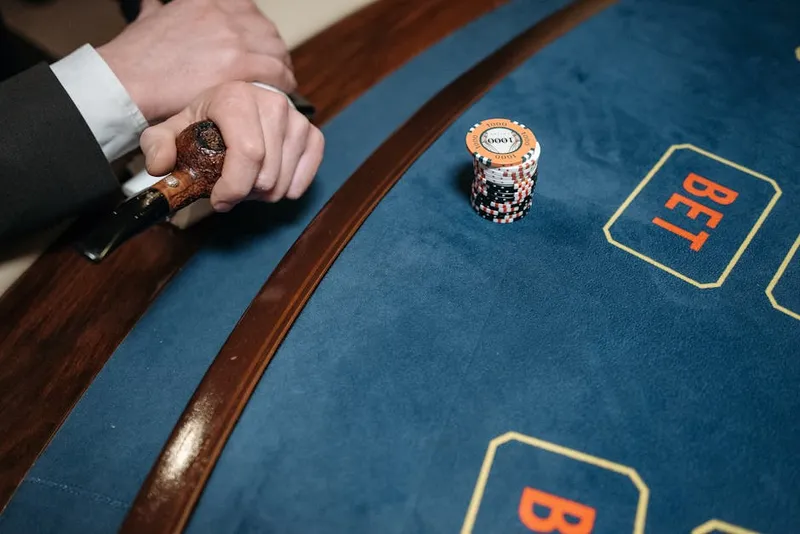
Pick the chart that matches the felt. Every casino prints a small placard on the table with the rules: deck count, dealer rule, double rules, split rules, surrender. Read the placard before you sit. If the rules do not match the chart in your head, the chart is wrong for that game.
A short list of plays that do not change across rulesets is worth burning in. Always split Aces. Always split 8s. Never split 5s. Never split 10s. Always hit hard 8 and below. Always stand on hard 17 and above. Always double 11 against dealer 2 through 10 (and on H17, against the Ace as well). Always stand on a pair of 9s against dealer 7 (the dealer is sliding into a 17). Always hit soft 17. Those rules survive every ruleset variant and account for a noticeable chunk of the chart. The remaining cells are the ones where the ruleset actually matters.
Where strategy charts stop being enough
A perfect basic strategy player at 6D H17 DAS LS is still down -0.47% to the house. The chart cannot pull you above zero. Counting and deviations do.
The deviations are the index plays that override the chart at specific true counts. Stand on hard 16 versus 10 at TC 0 or higher. Take insurance at TC +3. Stand on hard 12 versus 3 at TC +2. Double down on 10 versus 10 at TC +4. Split tens versus 5 at TC +5. The chart says hit hard 16 versus 10 always. The count says stand once the shoe is rich enough. The Illustrious 18 plus Fab 4 captures roughly 80% of available index EV with 22 plays.
This is where most self-taught counters bleed money they cannot see. They drill the chart, they learn the running count, they spread the bets, but they keep playing the chart when the count tells them to deviate. The gap between knowing the deviation and making the deviation under a chatty dealer with $500 on two hands is where most counters live for years. The session log will show the leak if you keep one. So will a coach reviewing the actual hand decisions before the call starts. Self-grading does not catch what self-grading does not know to look for.
Once basic strategy is automatic and the Hi-Lo true count conversion is clean, the deviations are the next layer. The chart is the foundation. The count is the trigger. The deviations are the engine.

What NOT to do with a blackjack strategy chart
A few rules that save more EV than the chart itself.
Do not use a chart that does not specify the ruleset. If it does not say H17 or S17, DAS or no-DAS, the chart is incomplete. Find one that does.
Do not consult the chart at the table. Memorize it. Drill it. Arrive with every play automatic. The pit notices the player who reads a card between hands, and the table notices the slowdown.
Do not deviate from the chart by feel. Hitting hard 12 versus 3 because it "feels right" gives back 1 to 2% of edge. The chart is built on hundreds of millions of simulated hands. Your gut is built on the last forty.
Do not skip the soft hands while drilling. Hard totals are easier and feel more productive to drill. Soft 18 is where the typical recreational player loses an extra half percent without realizing it.
Do not bring a basic strategy mindset into a counting session. If you are counting, you should be deviating. A counter who plays straight basic strategy through a +6 shoe is paying for the count and not using it. Flat-betting a positive count is worse than not counting at all, and so is flat-charting one.
Basic strategy is the cheapest piece of training in advantage play and the one people skip first. A sloppy basic strategy player who counts is donating more edge than the count will ever recover. The chart is free. The discipline to use it correctly is not.